EikonalWorks User's Manual
  • Workbench
  • IntensityView
Search Results for

    Show / Hide Table of Contents
    • Introduction
    • Installation and License Activation
    • User Interface
      • Keyboard Shortcuts
    • Supported File Formats
      • IES LM-63 Files
      • EULUMDAT Files
      • PHILLUM Files
      • EikonalWorks Intensity Files
      • IES TM-14 Files
      • IES TM-33 JSON Files
      • IES TM-33 XML Files
      • GLDF Files
    • View Modes
      • Sphere View
      • 3D View
      • 2D Map View
      • Table View
      • Illuminance View
      • Isocandela View
      • Polar And Cartesian Diagram View
      • Rendered Illuminance View
    • Edit Tools
      • Properties
      • Property Fields
      • Photometry Type And Resolution
      • Geometry Editor
      • Rotation
      • Symmetrize
      • Automatic Alignment
      • Smoothing And Denoising
      • Scale
      • Combine
      • Photometry Packaging Builder
    • Reports
      • UGR Table
      • UGR Chart
      • Soellner Diagram
      • Luminance Table
      • Utilization Factor Table
      • Uniformity Table
      • Zonal Lumen Table
      • Beam Spread
      • Luminaire Classification System
      • IES Roadway Report
      • Roadway Applicability
      • Color Plot
    • Tools
      • Photometry Modification Tool
      • Roadway Editor
      • Roadway Calculator
      • Roadway Generator
      • Roadway Optimizer
    • Plugins
      • LightTools Link
    • Miscellaneous
      • License Management

    Roadway Generator

    Roadway Generator

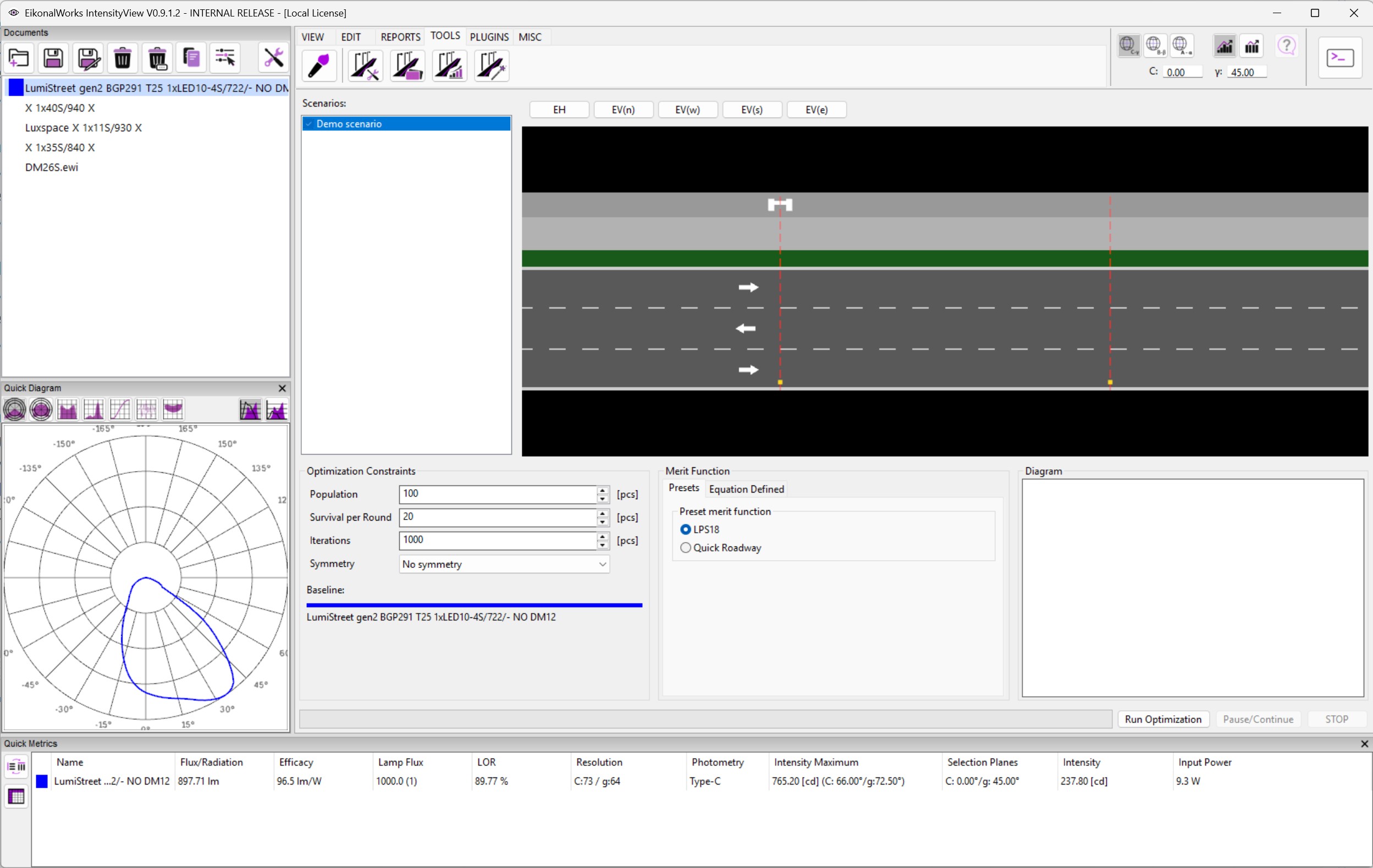
    The Roadway Generator creates an idealized luminous intensity distribution for selected roadway scenarios. It uses a genetic algorithm to mutate candidate intensity meshes and keep candidates with the best merit score.

    Scenario And Baseline

    Select and check the roadway scenarios that should drive the generator. If an intensity distribution is selected, it is used as the baseline. If none is selected, the tool creates a Lambertian 1000 lm baseline.

    Optimization Constraints

    • Population: number of candidates in each generation.
    • Survival per Round: number of best candidates kept for the next generation.
    • Iterations: number of generations to run.
    • Symmetry: constrains the generated distribution to no symmetry, bilateral symmetry, or quadrant symmetry.

    Merit Function

    The Presets tab provides built-in merit functions such as LPS18 and Quick Roadway. The Equation tab lists calculated terms as t1, t2, and so on, and lets an expression define the merit function.

    The generator maximizes merit. Preset functions reward passing roadway requirements and lower required luminous flux.

    Run Controls

    Run starts optimization. Pause/Continue pauses the process and stores an interim result when available. Stop cancels a paused run. The chart plots the best merit over the optimization history.

    Output

    When optimization finishes, the generated intensity distribution is added to the open project as a new photometry.

    In this article
    Back to top Generated by DocFX